Have you ever tried describing someone or something that just gets under your skin, but ordinary words like “annoying” feel flat? That’s where similes come in. In simple terms, a simile is a figure of speech that compares two different things using “like” or “as”. It turns ordinary writing into something vivid and memorable.
For example, instead of saying, “My little brother is annoying,” you might say, “My little brother is like a mosquito buzzing in my ear.” Instantly, your reader feels the irritation instead of just reading about it. Similes do more than add flair; they make your writing relatable and evoke strong emotions.
When you understand how to use them, you can describe not just annoying people, but frustrating situations, irritating habits, or pesky problems in ways that stick. And the best part? Anyone can do it. You don’t need fancy vocabulary, just imagination, observation, and the courage to compare things in creative ways.
Let’s explore some fun and practical similes for annoying that you can use in your writing.
20 Similes for Annoying
Here’s a handy list of similes that perfectly capture annoyance, with meaning, explanation, and example sentences.
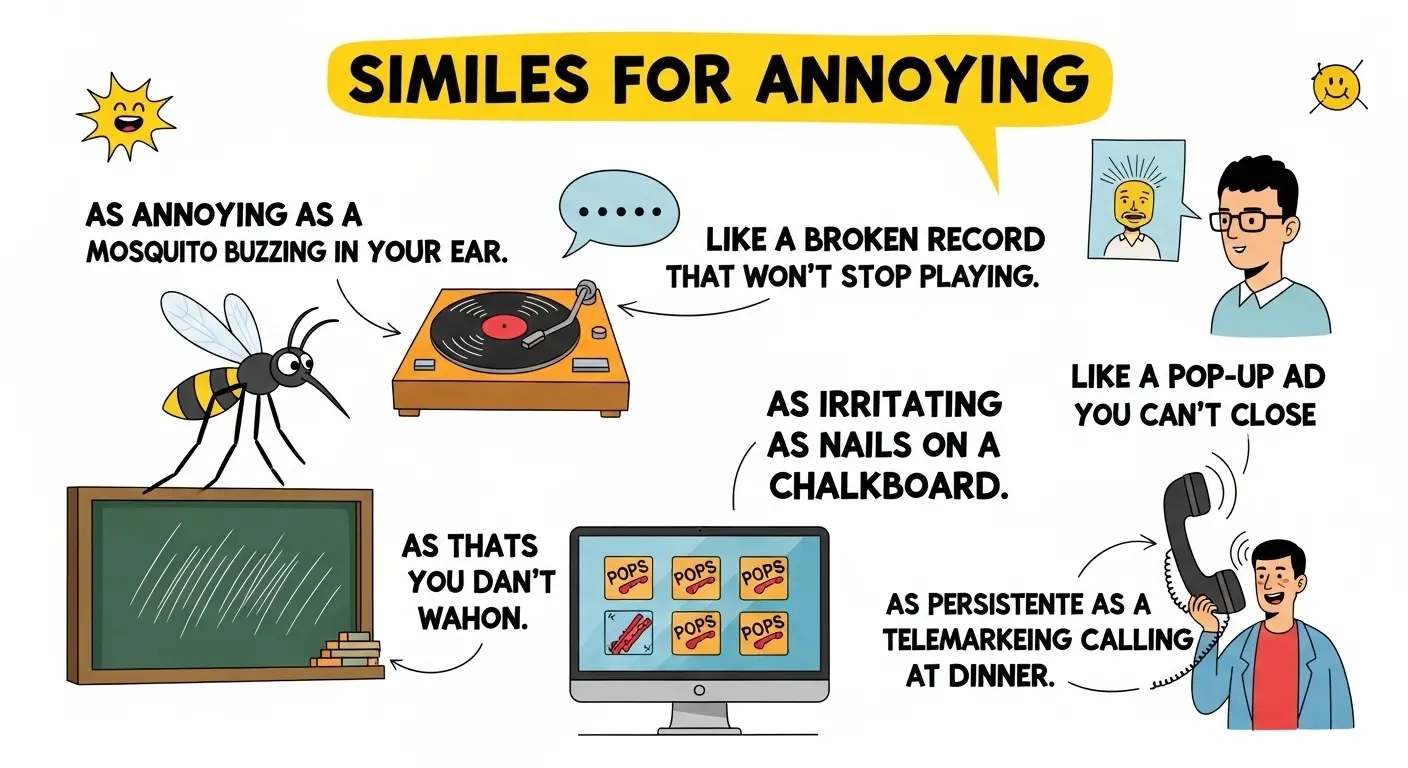
1. Like nails on a chalkboard
Meaning: Extremely irritating or grating.
Explanation: This conveys a sharp, unpleasant sensation.
Examples:
- His constant humming is like nails on a chalkboard.
- That screeching sound in the office was like nails on a chalkboard.
2. Like a mosquito buzzing in your ear
Meaning: Small but persistent annoyance.
Explanation: Highlights how minor things can irritate over time.
Examples:
- She kept asking questions like a mosquito buzzing in my ear.
- The repetitive notification ping was like a mosquito buzzing in my ear.
read more: Similes for Abandoned:(With Meaning and Examples ) of 2026
3. Like a dripping faucet
Meaning: Constantly irritating with repetition.
Explanation: Shows how repeated actions can wear on patience.
Examples:
- His endless complaining was like a dripping faucet.
- That coworker’s questions were like a dripping faucet during the meeting.
4. Like sand in your shoes
Meaning: Uncomfortable and annoying.
Explanation: Conveys small, persistent irritation that disrupts comfort.
Examples:
- Her nagging was like sand in my shoes.
- The tiny errors in the report were like sand in my shoes.
Read more: Similes for Feeling Trapped:(With Meaning & Examples) 2026
5. Like a squeaky wheel
Meaning: Someone who constantly demands attention.
Explanation: Suggests attention-seeking annoyance.
Examples:
- He complains like a squeaky wheel until he gets noticed.
- That child in class acted like a squeaky wheel all morning.
6. Like a pop-up ad that won’t close
Meaning: Persistent and irritating.
Explanation: Modern, relatable annoyance from technology.
Examples:
- Her constant interruptions were like a pop-up ad that won’t close.
- The spam messages were like a pop-up ad that won’t close.
7. Like a buzzing alarm clock at midnight
Meaning: Sudden and jarring annoyance.
Explanation: Highlights how disruptive and frustrating it can feel.
Examples:
- That unexpected comment was like a buzzing alarm clock at midnight.
- His loud laugh during the movie was like a buzzing alarm clock at midnight.
8. Like a stuck record
Meaning: Repeating the same thing annoyingly.
Explanation: Illustrates monotony that irritates the listener.
Examples:
- She kept reminding me like a stuck record.
- His endless complaints sounded like a stuck record.
9. Like a pebble in your shoe
Meaning: Small irritation that is hard to ignore.
Explanation: Shows how minor things can cause discomfort over time.
Examples:
- That tiny typo felt like a pebble in my shoe.
- His comments were like a pebble in my shoe all day.
10. Like a fly at a picnic
Meaning: Unwanted, persistent, annoying presence.
Explanation: Highlights intrusion and irritation.
Examples:
- He hovered around like a fly at a picnic.
- Her questions were like a fly at a picnic during the meeting.
11. Like static on the radio
Meaning: Distracting and irritating.
Explanation: Annoyance that interrupts attention.
Examples:
- His chatter was like static on the radio.
- The interruptions were like static on the radio while I worked.
12. Like a barking dog at 3 a.m.
Meaning: Loud, persistent, and disturbing.
Explanation: Conveys irritation that’s impossible to ignore.
Examples:
- The debate was like a barking dog at 3 a.m..
- Her laughter sounded like a barking dog at 3 a.m. through the walls.
13. Like a broken record player
Meaning: Repeating frustratingly.
Explanation: Emphasizes endless repetition.
Examples:
- He kept explaining like a broken record player.
- That topic feels like a broken record player in every class.
14. Like a dripping ice cube
Meaning: Persistent and slightly irritating.
Explanation: Minor annoyances that continue to bother.
Examples:
- Her tapping was like a dripping ice cube.
- The leak in the sink was like a dripping ice cube.
15. Like a persistent mosquito
Meaning: Continuous, nagging irritation.
Explanation: Highlights minor but relentless annoyance.
Examples:
- The sales calls were like a persistent mosquito.
- His constant chatter was like a persistent mosquito.
16. Like an unexpected rain on laundry day
Meaning: Sudden, inconvenient annoyance.
Explanation: Suggests frustration from bad timing.
Examples:
- The extra homework was like an unexpected rain on laundry day.
- That comment felt like an unexpected rain on laundry day.
17. Like a dripping pen on paper
Meaning: Subtle, repeated irritation.
Explanation: Shows a slow, ongoing annoyance.
Examples:
- The teacher’s red pen marks were like a dripping pen on paper.
- His reminders were like a dripping pen on paper all morning.
18. Like a squeaky door hinge
Meaning: Small but annoying sound.
Explanation: Conveys minor irritation that persists.
Examples:
- Her laughter was like a squeaky door hinge.
- The office chair groaned like a squeaky door hinge.
19. Like static on a phone line
Meaning: Interrupting and irritating.
Explanation: Modern annoyance disrupting communication.
Examples:
- His voice was like static on a phone line.
- That Wi-Fi glitch felt like static on a phone line.
20. Like a kid asking “why” nonstop
Meaning: Persistent questioning that’s annoying.
Explanation: Emphasizes repeated irritation from curiosity or nagging.
Examples:
- Her questions were like a kid asking “why” nonstop.
- His constant follow-ups were like a kid asking “why” nonstop.
Practical Exercise: Identify or Complete the Simile
Questions:
- My little brother’s humming is ________ like _________.
- The repetitive notifications were ________ like _________.
- Her constant interruptions were ________ like _________.
- His complaining sounded ________ like _________.
- That squeaky chair felt ________ like _________.
- The barking dog at night was ________ like _________.
- The dripping faucet is ________ like _________.
- Her endless chatter felt ________ like _________.
- The spam emails were ________ like _________.
- The repeated mistakes in the report were ________ like _________.
Answers with Explanations:
- like a mosquito buzzing in your ear – small but persistent annoyance
- like a pop-up ad that won’t close – constant interruption
- like a squeaky wheel – demanding attention
- like a broken record player – repeating endlessly
- like a squeaky door hinge – minor persistent sound
- like a barking dog at 3 a.m. – impossible to ignore
- like a dripping faucet – repetition wearing on patience
- like a persistent mosquito – continuous minor irritation
- like a pop-up ad that won’t close – persistent intrusion
- like sand in your shoes – small irritation over time
Conclusion :
Similes are an essential tool for creative writing because they help your reader feel what you mean instead of just reading it. When describing something annoying, similes allow you to capture both the intensity and nature of the irritation in a relatable way.
If it’s like nails on a chalkboard or like a mosquito buzzing in your ear, each simile paints a vivid mental image.By practicing these similes and experimenting with your own, you can make your writing more expressive, memorable, and engaging.
The next time something or someone is annoying, try turning it into a simile you’ll bring your sentences to life and connect with your reader emotionally.