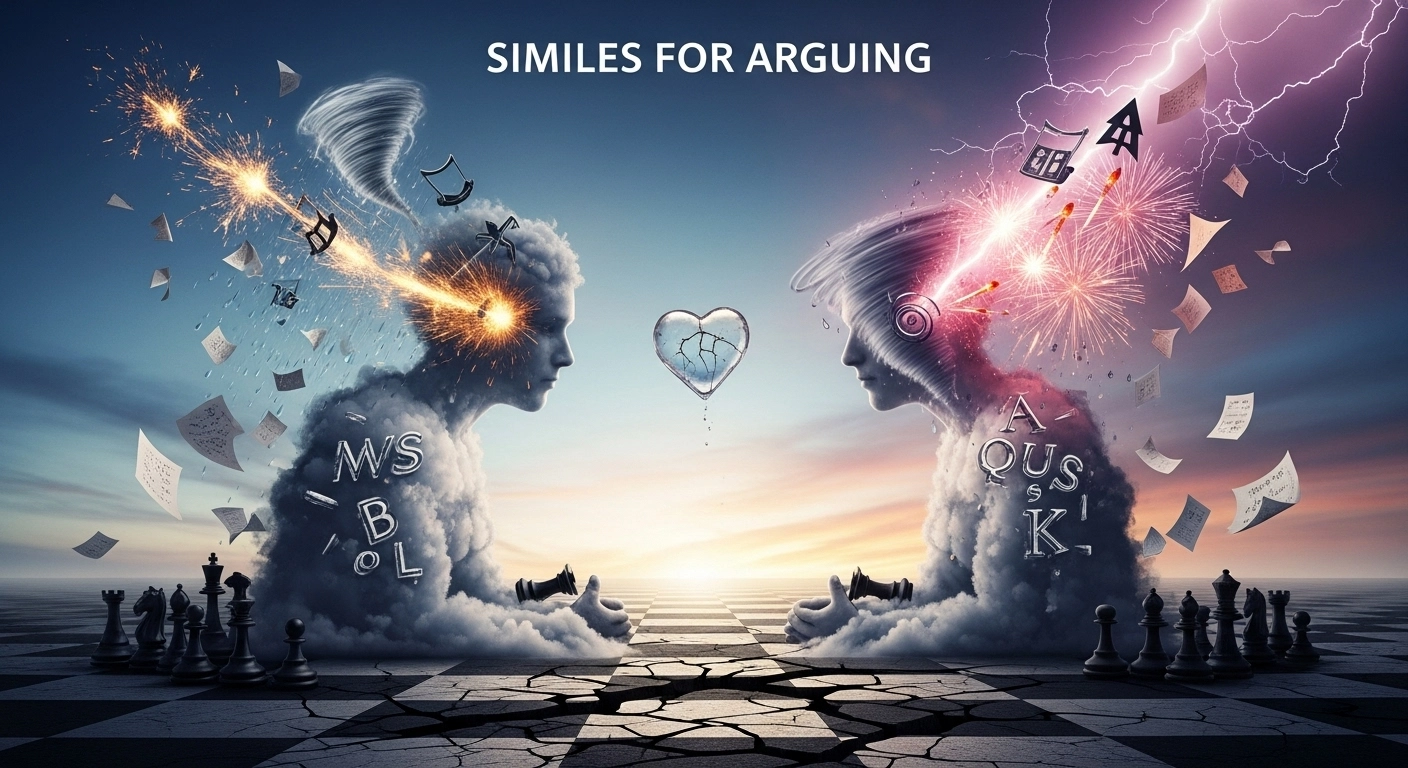
Let’s be honest arguing is something we all understand.If it’s a small disagreement with a friend or a loud debate in a story, arguments show strong emotions.
But when you write about arguing, simply saying “they argued” can feel boring or flat. That’s where similes for arguing come in.
In simple terms, similes help you show what an argument feels like instead of just telling it. They compare arguing to something familiar, using words like “as” or “like.”
For example, saying “they argued like cats and dogs” instantly paints a picture in your mind. You can almost hear the noise and feel the tension.
If you’re new to creative writing, don’t worry. Similes are easy to learn and fun to use. They make your sentences more colorful, more emotional, and more memorable.
In this guide, let’s explore what similes are, how to use them in writing, and some powerful examples of similes for arguing.
By the end, you’ll feel confident creating your own simple sentences naturally.
What Is a Simile? (Explained Simply)
A simile is a figure of speech that compares two different things using “like” or “as.”
The meaning of similes is simple: they help readers understand feelings, actions, or situations more clearly.
For example, instead of saying “they were arguing loudly,” you might say:
“They were arguing like a thunderstorm crashing indoors.”
Similes enhance writing by adding emotion, imagery, and creativity. In creative writing, similes make scenes feel alive and real. Once you learn how to use similes in writing, your storytelling becomes much stronger.
20 Powerful Similes for Arguing (With Meaning & Examples)
1. Arguing like cats and dogs
Meaning: Constant, noisy fighting
Conveys: Chaos and tension
Examples:
- They argue like cats and dogs every morning.
- The siblings argued like cats and dogs over the TV remote.
2. Arguing like a broken record
Meaning: Repeating the same points
Conveys: Frustration and stubbornness
Examples:
- He argued like a broken record, saying the same thing again.
- The debate felt endless, like a broken record playing.
3. Arguing like thunder and lightning
Meaning: Loud and intense arguing
Conveys: Sudden emotional clashes
Examples:
- Their voices clashed like thunder and lightning.
- The room shook as they argued like a storm.
4. Arguing like fire and fuel
Meaning: Each word makes it worse
Conveys: Escalation
Examples:
- Every reply was fuel on the fire of their argument.
- They argued like fire meeting dry wood.
5. Arguing like barking dogs
Meaning: Loud but pointless arguing
Conveys: Noise without solution
Examples:
- They kept arguing like barking dogs.
- The meeting turned into barking with no results.
6. Arguing like a boiling kettle
Meaning: Growing anger
Conveys: Emotional pressure
Examples:
- His anger boiled like a kettle ready to scream.
- The argument heated up like boiling water.
7. Arguing like two rams
Meaning: Head-to-head stubborn fight
Conveys: Ego clash
Examples:
- They argued like two rams locking horns.
- Neither side would back down.
8. Arguing like a stormy sea
Meaning: Emotional ups and downs
Conveys: Turmoil
Examples:
- Their argument rose and fell like waves.
- The conversation felt rough like a stormy sea.
9. Arguing like clashing swords
Meaning: Sharp verbal attacks
Conveys: Verbal aggression
Examples:
- Their words clashed like swords in battle.
- Every sentence cut deeper.
10. Arguing like a ticking bomb
Meaning: Tension ready to explode
Conveys: Danger
Examples:
- The silence before they argued felt like a ticking bomb.
- One word set it off.
11. Arguing like kids in a playground
Meaning: Immature arguing
Conveys: Lack of seriousness
Examples:
- They argued like kids fighting over toys.
- It felt childish and loud.
12. Arguing like a buzzing fly
Meaning: Annoying and constant
Conveys: Irritation
Examples:
- His complaints buzzed like a fly.
- The argument wouldn’t stop.
13. Arguing like echoing voices
Meaning: No one listening
Conveys: Futility
Examples:
- Their voices echoed with no understanding.
- The argument went nowhere.
14. Arguing like shaking ground
Meaning: Powerful disagreement
Conveys: Emotional impact
Examples:
- The argument shook the room like an earthquake.
- Everyone felt it.
15. Arguing like snapping wolves
Meaning: Aggressive argument
Conveys: Hostility
Examples:
- They snapped at each other like wolves.
- The tension was fierce.
16. Arguing like clanging metal
Meaning: Harsh sounds
Conveys: Unpleasant conflict
Examples:
- Their voices clanged like metal hitting metal.
- It hurt to listen.
17. Arguing like a raging fire
Meaning: Out-of-control argument
Conveys: Destruction
Examples:
- The argument spread like wildfire.
- No one could stop it.
18. Arguing like birds fighting crumbs
Meaning: Small but loud argument
Conveys: Petty conflict
Examples:
- They argued over nothing like birds over crumbs.
- It felt unnecessary.
19. Arguing like cracking ice
Meaning: Cold, sharp arguing
Conveys: Emotional distance
Examples:
- Their words cracked like ice.
- The argument felt cold and sharp.
20. Arguing like a broken engine
Meaning: Loud and messy
Conveys: Disorder
Examples:
- The argument sputtered like a broken engine.
- Nothing made sense anymore.
Practical Exercise: Practice Similes for Arguing
Questions (Try First!)
- Complete: They argued like ___ and dogs.
- Which simile shows repeated arguing?
- Fill in: Their argument spread like ___.
- Which simile means stubborn conflict?
- Complete: His anger boiled like a ___.
- Identify the simile: “Their words clashed like swords.”
- Which simile shows childish arguing?
- Fill in: The tension felt like a ticking ___.
- Which simile means loud but pointless arguing?
- Complete: They snapped like ___.
Answers with Explanations
- Cats – shows constant fighting
- Broken record – repetition
- Wildfire – fast-spreading conflict
- Two rams – stubbornness
- Kettle – rising anger
- Like swords – verbal attacks
- Kids in a playground – immature arguing
- Bomb – ready to explode
- Barking dogs – noise without meaning
- Wolves – aggression
Conclusion :
Similes are powerful tools in creative writing. They help you explain emotions, actions, and conflicts in a way that feels real and relatable. When it comes to writing about conflict, similes for arguing make your sentences stronger and more engaging. Instead of flat descriptions, you give readers clear images and feelings.
As you’ve seen, learning how to use similes in writing doesn’t have to be hard. With simple comparisons and practice, anyone can improve their storytelling. Now it’s your turn try creating your own simile sentences based on arguments you’ve seen or imagined. The more you practice, the more natural it will feel.

I am Liam Payne is a renowned British singer and songwriter, formerly of One Direction. His solo career and unique style have inspired fans worldwide simlixs.com.