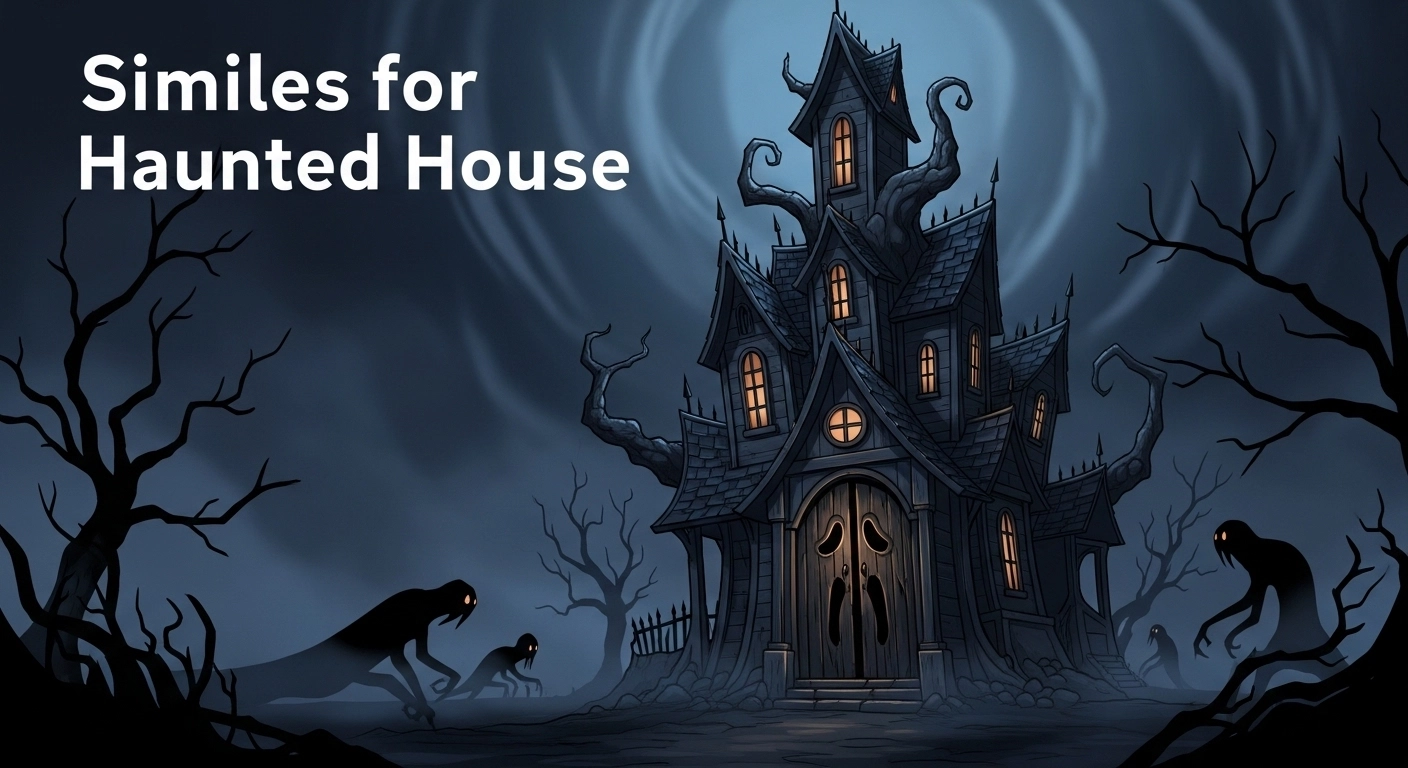
If you’ve ever tried to describe a haunted house in writing, you know how tricky it can be. You want the place to feel spooky, quiet, creepy, and alive all at once. This is where similes come in and save the day.
Similes help turn plain descriptions into vivid pictures that readers can feel. In simple terms, similes compare one thing to another using words like “as” or “like.” They help your reader imagine what you see in your mind.
Instead of just saying “the house was scary,” a simile lets you say something more creative and memorable. For example, you might say the house stood like a silent monster waiting in the dark.
In creative writing, especially spooky or horror scenes, similes add mood, emotion, and detail. They make your writing more fun to read and easier to imagine.
In this guide, we’ll explore clear examples of similes for a haunted house, explain their meaning, and show how to use them naturally in sentences. By the end, you’ll feel confident creating your own haunted house similes.
Let’s explore together.
20 Similes for a Haunted House (With Meaning & Examples)
1. Silent Monster
Simile: The haunted house stood like a silent monster watching the road.
Meaning: The house feels alive and threatening.
Explanation: It shows danger without movement.
Examples:
- The haunted house loomed like a silent monster.
- At night, it felt like a silent monster staring at us.
2. Graveyard at Midnight
Simile: The house was as quiet as a graveyard at midnight.
Meaning: Complete silence and fear.
Explanation: Silence adds tension.
Examples:
- Inside, it was as quiet as a graveyard at midnight.
- The halls stayed as quiet as a graveyard at midnight.
Read more: Similes for Tension:(Meaning with Examples) of 2026
3. Skeleton’s Ribcage
Simile: The broken walls looked like a skeleton’s ribcage.
Meaning: Old and decaying.
Explanation: Shows death and ruin.
Examples:
- The walls stood like a skeleton’s ribcage.
- Vines wrapped around it like ribs.
4. Sleeping Giant
Simile: The house rested like a sleeping giant.
Meaning: Large and powerful.
Explanation: Suggests hidden danger.
Examples:
- The house sat like a sleeping giant.
- At dawn, it still looked like a sleeping giant.
Read more: Similes for War Poems: Powerful Examples Explained Simply
5. Dark Cave
Simile: The doorway opened like a dark cave.
Meaning: Unknown and scary.
Explanation: Fear of what’s inside.
Examples:
- The door gaped like a dark cave.
- We feared stepping into that cave-like entrance.
6. Whispering Ghost
Simile: The wind moved like a whispering ghost.
Meaning: Soft but creepy sound.
Explanation: Builds atmosphere.
Examples:
- The wind passed like a whispering ghost.
- The night felt alive with ghostly whispers.
7. Spider’s Trap
Simile: The house felt like a spider’s trap.
Meaning: Hard to escape.
Explanation: Suggests danger.
Examples:
- Walking inside felt like a spider’s trap.
- Every step pulled us deeper.
8. Watching Eyes
Simile: The windows stared like watching eyes.
Meaning: Feeling observed.
Explanation: Creates unease.
Examples:
- Windows glared like watching eyes.
- I avoided their gaze.
9. Rotten Tooth
Simile: The house stood like a rotten tooth.
Meaning: Ugly and decayed.
Explanation: Shows neglect.
Examples:
- The house looked like a rotten tooth.
- It spoiled the whole street.
10. Coffin
Simile: The hallway felt like a coffin.
Meaning: Tight and scary.
Explanation: Fear of death.
Examples:
- The hallway closed in like a coffin.
- Breathing felt hard.
11. Frozen Breath
Simile: The air was cold like frozen breath.
Meaning: Unnatural chill.
Explanation: Adds ghostly feel.
Examples:
- The room felt cold like frozen breath.
- Even summer couldn’t warm it.
12. Waiting Shadow
Simile: Shadows moved like they were waiting.
Meaning: Suspense.
Explanation: Makes shadows feel alive.
Examples:
- Shadows lingered like they were waiting.
- I didn’t trust the darkness.
13. Broken Memory
Simile: The house felt like a broken memory.
Meaning: Past pain.
Explanation: Emotional depth.
Examples:
- The house felt like a broken memory.
- It reminded me of something terrible.
14. Creaking Bones
Simile: The stairs creaked like old bones.
Meaning: Age and weakness.
Explanation: Adds sound detail.
Examples:
- The stairs cracked like old bones.
- Every step made noise.
15. Trapped Scream
Simile: The walls echoed like a trapped scream.
Meaning: Past horror.
Explanation: Suggests suffering.
Examples:
- The walls rang like trapped screams.
- Silence followed each echo.
16. Foggy Dream
Simile: The house looked like a foggy dream.
Meaning: Unreal feeling.
Explanation: Confusion and fear.
Examples:
- The house faded like a foggy dream.
- It didn’t feel real.
17. Dark Secret
Simile: The house hid secrets like a locked diary.
Meaning: Mystery.
Explanation: Invites curiosity.
Examples:
- The house felt like a locked diary.
- I wanted answers.
18. Lonely Widow
Simile: The house waited like a lonely widow.
Meaning: Sad and abandoned.
Explanation: Adds emotion.
Examples:
- It stood like a lonely widow.
- Time had forgotten it.
19. Cursed Story
Simile: The house felt like a cursed story.
Meaning: Bad history.
Explanation: Suggests danger.
Examples:
- Entering felt like stepping into a cursed story.
- No one escaped unchanged.
20. Breathing Darkness
Simile: The darkness moved like it was breathing.
Meaning: Alive and scary.
Explanation: Heightens fear.
Examples:
- The darkness breathed around us.
- I froze in place.
Practical Exercise: Practice Using Similes
Questions
- Complete: The haunted house was as quiet as _______.
- Identify the smile: “The windows stared like eyes.”
- Fill in: The stairs creaked like _______.
- Which word shows comparison: like or loud?
- Complete: The doorway opened like a _______.
- Identify the simile: “The house felt like a trap.”
- Fill in: Shadows waited like _______.
- Is this a simile? “The house was scary.”
- Complete: The air was cold like _______.
- Identify the simile: “The hallway felt like a coffin.”
Answers & Explanations
- Graveyard at midnight – shows silence
- “like eyes” – compares windows to eyes
- Old bones – shows age
- Like – comparison word
- Dark cave – fear of unknown
- Yes – compares house to trap
- Waiting shadows – suspense
- No – no comparison word
- Frozen breath – cold feeling
- Yes – compares hallway to coffin
Conclusion
Similes are one of the easiest and most powerful tools in creative writing. They help turn simple ideas into clear pictures that readers can imagine and feel. When writing about a haunted house, similes add fear, mood, and emotion without using too many words.
By learning the meaning of similes and practicing simile sentences, you improve your storytelling skills naturally. You don’t need fancy language just honest comparisons that make sense. As you write, try asking yourself, “What does this feel like?” Then turn that feeling into a simile.
Keep practicing, keep experimenting, and soon creating haunted house similes will feel natural. Happy writing!

I am James is a passionate writer and educator at Simlixs.com, where he focuses on making creative writing simple, engaging, and easy to understand. His goal is to help students, beginners, and language learners improve their writing skills through clear explanations and relatable examples.