If you’re learning creative writing, you’ve probably heard about similes but they can still feel confusing at first. Don’t worry. You’re not alone.
In simple terms, a simile is a fun way to compare two different things using words like “as” or like.” These comparisons help readers picture ideas more clearly.
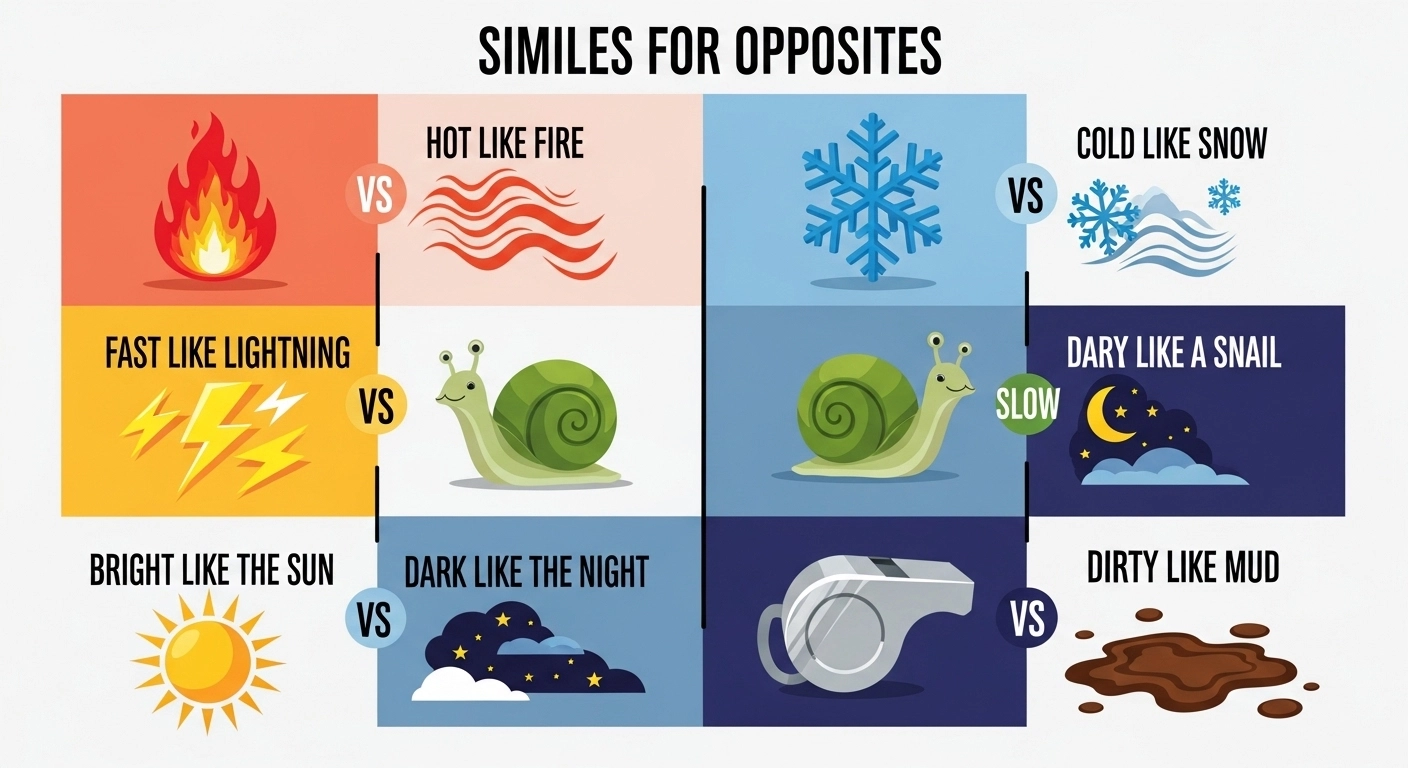
Now, when we talk about similes for opposites, we’re focusing on comparisons that show strong contrasting things that are very different from each other.
For example, hot versus cold, light versus dark, fast versus slow. These kinds of similes make writing more colorful and interesting. Similes are powerful because they turn plain sentences into memorable ones.
Instead of saying something is “very different,” you can show that difference with an image the reader instantly understands.
In this guide, let’s explore clear examples of similes, learn their meanings, and practice using them naturally. By the end, you’ll feel confident spotting similes and creating your own with ease.
20 Similes for Opposite (With Meaning & Examples)
1. Night and Day
- Simile: As different as night and day
- Meaning: Completely opposite
- Explanation: Shows total contrast
- Examples:
- Their opinions are as different as night and day.
- City life and village life feel like night and day.
2. Fire and Ice
- Simile: Like fire and ice
- Meaning: Totally opposite personalities
- Explanation: One is intense, the other calm
- Examples:
- They argue like fire and ice.
- Her anger and his patience were like fire and ice.
- Read more: Similes for Middle School: Simple Examples to Make Writing Fun
3. Sun and Moon
- Simile: Like the sun and the moon
- Meaning: Never the same
- Explanation: Shows contrast and distance
- Examples:
- Their schedules are like the sun and the moon.
- His mood today was like the sun and the moon from yesterday.
4. Black and White
- Simile: As different as black and white
- Meaning: Very clear opposite
- Explanation: No middle ground
- Examples:
- Right and wrong felt black and white to her.
- Their styles are as different as black and white.
- Read more: Similes for Realization:(With Meaning, Examples, and Practice)
5. Heaven and Earth
- Simile: Like heaven and earth
- Meaning: Extremely different
- Explanation: Strong emotional contrast
- Examples:
- Life before and after school was like heaven and earth.
- The two jobs felt like heaven and earth.
6. Hot and Cold
- Simile: Like hot and cold
- Meaning: Opposite reactions
- Explanation: Sudden emotional change
- Examples:
- His behavior switches between hot and cold.
- She was warm yesterday but cold today.
7. Light and Shadow
- Simile: Like light and shadow
- Meaning: One bright, one dark
- Explanation: Moral or emotional contrast
- Examples:
- Their choices were like light and shadow.
- Hope and fear stood like light and shadow.
8. North and South
- Simile: As far apart as north and south
- Meaning: Totally opposite views
- Explanation: Directional contrast
- Examples:
- Their ideas are north and south.
- We are thinking in north and south directions.
9. Day and Night
- Simile: Like day and night
- Meaning: Complete change
- Explanation: Clear transformation
- Examples:
- His confidence is day and night now.
- The place looks day and night after renovation.
10. Fire and Water
- Simile: Like fire and water
- Meaning: Cannot mix
- Explanation: Natural opposites
- Examples:
- Their friendship is like fire and water.
- Anger and peace feel like fire and water.
11. Up and Down
- Simile: Like up and down
- Meaning: Changing extremes
- Explanation: Emotional contrast
- Examples:
- His mood goes up and down.
- Life feels like up and down sometimes.
12. Stone and Feather
- Simile: Like a stone and a feather
- Meaning: Heavy vs light
- Explanation: Physical or emotional weight
- Examples:
- Guilt felt like a stone, relief like a feather.
- His words hit like stone, hers like a feather.
13. Winter and Summer
- Simile: Like winter and summer
- Meaning: Extreme difference
- Explanation: Seasonal contrast
- Examples:
- Their attitudes are winter and summer.
- Her smile changed winter to summer.
14. Fast and Slow
- Simile: Like a racecar and a turtle
- Meaning: Speed difference
- Explanation: Movement contrast
- Examples:
- He works like a racecar, I move like a turtle.
- The day passed fast and slow at once.
15. Sweet and Sour
- Simile: Like sweet and sour
- Meaning: Mixed opposites
- Explanation: Emotional contrast
- Examples:
- The memory tasted sweet and sour.
- Winning felt sweet, losing felt sour.
16. Open and Closed
- Simile: Like an open door and a locked one
- Meaning: Welcoming vs rejecting
- Explanation: Emotional availability
- Examples:
- Her heart felt like a locked door.
- He welcomed ideas like an open door.
17. Warm and Cold
- Simile: Like a warm fire and cold ice
- Meaning: Emotional contrast
- Explanation: Feelings difference
- Examples:
- Her smile was warm, his silence cold.
- Their reactions were fire and ice.
18. Noise and Silence
- Simile: Like noise and silence
- Meaning: Total opposite atmosphere
- Explanation: Sound contrast
- Examples:
- The house went from noise to silence.
- His mind felt noisy, hers silent.
19. Full and Empty
- Simile: Like a full cup and an empty one
- Meaning: Complete vs lacking
- Explanation: Emotional or physical state
- Examples:
- His heart felt full, mine empty.
- Hope filled one, fear emptied the other.
20. Straight and Crooked
- Simile: Like a straight road and a crooked path
- Meaning: Honest vs dishonest
- Explanation: Moral contrast
- Examples:
- His life followed a straight road.
- Lies lead down crooked paths.
Practical Exercise: Practice Similes (With Answers)
Questions
- Complete: As different as ___ and ___.
- Identify the simile: “Their ideas were like fire and water.”
- Fill in: Like ___ and ___.
- What simile shows light vs dark?
- Complete: As far apart as ___ and ___.
- Identify the simile word in the sentence.
- Choose the opposite simile for calm vs anger.
- Fill in: Like winter and ___.
- Identify if this is a simile: “He was angry like fire.”
- Write one simile for opposite feelings.
Answers & Explanations
- Night and day – shows total difference
- Fire and water – natural opposites
- Black and white – clear contrast
- Light and shadow – brightness vs darkness
- North and south – opposite directions
- “Like” – simile word
- Fire and ice – emotional opposites
- Summer – seasonal contrast
- Yes – it uses “like”
- Example: Happy like sunshine, sad like rain
Conclusion
Similes are one of the easiest and most powerful tools in creative writing. They help you explain ideas clearly, paint strong pictures, and keep your reader engaged. When you use similes for the opposite, your writing becomes more expressive and meaningful because contrast grabs attention.
By practicing these simile sentences, you learn not only the meaning of similes but also how to use similes in writing naturally. Start small. Compare emotions, objects, or ideas you see every day. Soon, creating similes will feel easy and even fun.
So go ahead. Pick two opposites and let your imagination connect them. Your writing will thank you.

I am James is a passionate writer and educator at Simlixs.com, where he focuses on making creative writing simple, engaging, and easy to understand. His goal is to help students, beginners, and language learners improve their writing skills through clear explanations and relatable examples.