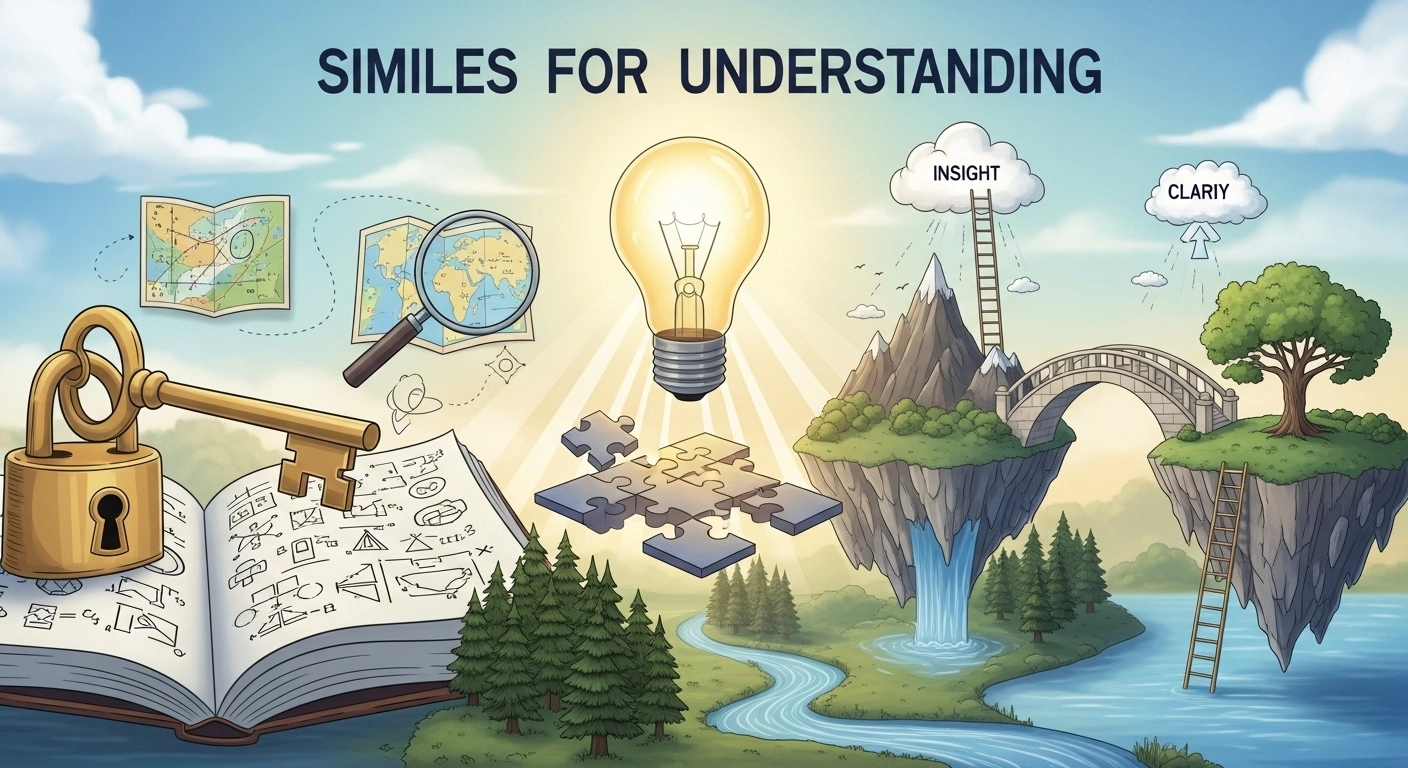
If you’ve ever tried to explain something tricky like a new idea, a feeling, or a lesson you know it’s not always easy. That’s where similes come in.
In simple terms, similes help us compare one thing to another using words like “like” or as.” They turn confusion into clarity.
Think of similes as little bridges. They connect something new to something familiar. For example, saying “learning is like climbing a ladder” instantly helps the reader understand the process step by step.
In creative writing, similes make ideas feel alive. They help readers see, feel, and get what you’re saying without overexplaining. Instead of long explanations, one good simile can do the job beautifully.
In this guide, we’ll explore similes for understanding only. You’ll see clear examples of similes used in context, learn their meanings, and practice creating your own. No complicated rules, just easy learning, like we’re talking face-to-face.
So, let’s explore how similes can make understanding clearer, smoother, and more fun
20 Similes for Understanding (With Meaning & Examples)
1. Understanding is like a light turning on
Meaning: Suddenly realizing something.
What it conveys: Clarity after confusion.
- When she explained it, understanding was like a light turning on.
- His words were like a switch that lit up my mind.
2. Understanding is like fitting puzzle pieces together
Meaning: Ideas slowly make sense.
What it conveys: Logical connection.
- The lesson felt like fitting puzzle pieces together.
- Each example helped the puzzle come together.
3. Understanding is like clearing fog from a window
Meaning: Seeing clearly after confusion.
What it conveys: Mental clarity.
- His explanation cleared the fog from my thoughts.
- The teacher wiped the fog from our understanding.
4. Understanding is like unlocking a door
Meaning: Gaining access to knowledge.
What it conveys: New possibilities.
- One question unlocked the door to understanding.
- Reading helped unlock ideas I couldn’t reach before.
5. Understanding is like connecting the dots
Meaning: Seeing the full picture.
What it conveys: Insight.
- Slowly, I connected the dots and understood.
- The example helped her connect everything.
6. Understanding is like learning to ride a bike
Meaning: Difficult at first, easy later.
What it conveys: Practice leads to mastery.
- At first it was hard, but understanding came like riding a bike.
- Once learned, it stayed with me.
7. Understanding is like a key in the right lock
Meaning: The correct explanation matters.
What it conveys: Precision.
- That example was the key to my understanding.
- One sentence unlocked the idea.
8. Understanding is like sunrise after night
Meaning: Knowledge replaces confusion.
What it conveys: Hope and clarity.
- Understanding rose like the sun after darkness.
- The lesson felt brighter by the end.
9. Understanding is like reading a map
Meaning: Knowing where to go.
What it conveys: Direction.
- The instructions helped me read the map of the topic.
- Without guidance, I felt lost.
10. Understanding is like water soaking into soil
Meaning: Learning slowly and deeply.
What it conveys: Absorption.
- The idea soaked in over time.
- Repetition helped the lesson sink in.
11. Understanding is like tuning a radio
Meaning: Finding the right frequency.
What it conveys: Focus.
- Once tuned correctly, the idea was clear.
- His explanation removed the static.
12. Understanding is like opening a book
Meaning: Gaining knowledge.
What it conveys: Learning.
- Her explanation opened a new chapter for me.
- Every lesson felt like a new page.
13. Understanding is like building a bridge
Meaning: Linking ideas together.
What it conveys: Connection.
- Examples built a bridge between theory and practice.
- The simile helped bridge the gap.
14. Understanding is like seeing in daylight
Meaning: Clear and obvious comprehension.
What it conveys: Visibility.
- Once explained, it was clear as daylight.
- The confusion disappeared instantly.
15. Understanding is like solving a riddle
Meaning: Figuring something out.
What it conveys: Satisfaction.
- Solving the problem felt like cracking a riddle.
- Each clue helped me understand.
16. Understanding is like putting on glasses
Meaning: Seeing things better.
What it conveys: Sharpness.
- The example was like putting on glasses.
- Suddenly, everything looked clearer.
17. Understanding is like climbing a hill
Meaning: Effort leads to clarity.
What it conveys: Progress.
- The climb was hard, but the view was worth it.
- Understanding came at the top.
18. Understanding is like a puzzle finally complete
Meaning: Full comprehension.
What it conveys: Completion.
- Everything made sense once the puzzle was complete.
- The final example sealed it.
19. Understanding is like a seed growing
Meaning: Learning develops over time.
What it conveys: Growth.
- The idea grew slowly in my mind.
- Practice helped it grow stronger.
20. Understanding is like calm water after waves
Meaning: Peace after confusion.
What it conveys: Mental ease.
- After the explanation, my mind felt calm.
- The chaos settled into clarity.
Practical Exercise: Practice Similes (With Answers)
Questions
- Complete: Understanding is like ______ turning on.
- Identify the simile: Learning felt like fitting pieces together.
- Fill in: Understanding is like unlocking a ______.
- Which word signals a simile: as or because?
- Complete: Understanding came like ______ after night.
- Identify: The lesson soaked in slowly.
- Fill in: Understanding is like reading a ______.
- Choose the simile:
a) I understand now
b) Understanding is like seeing daylight - Complete: Understanding is like putting on ______.
- Identify the simile phrase: Connecting the dots made sense.
Answers & Explanations
- a light – shows sudden clarity
- Like fitting pieces together – comparison using “like”
- door – shows access to knowledge
- as – common simile word
- sunrise – shows clarity
- Soaked in – compares learning to water
- map – shows direction
- b – comparison is present
- glasses – clearer vision
- Connecting the dots – comparison of ideas
Conclusion
Similes are powerful tools in creative writing because they help readers understand without struggle. Instead of long explanations, similes paint clear pictures in the mind. They make writing more engaging, friendly, and memorable.
When you use similes for understanding, you guide your reader gently like holding their hand through a new idea. If you’re writing a story, an essay, or even a simple paragraph, similes can turn confusion into clarity.
Now it’s your turn. Try creating your own similes. Ask yourself: What does understanding feel like to me? Compare it to something familiar, and let your words do the magic .
About The Author